agtech · livestock management
Pecuadex
Web-based livestock management: pens, animals with genealogy and status tracking calf, gestating, critical and production records, with real-time animal lookup.
Built · in development, not commercial
Context
On a livestock operation, tracking every animal by hand location, health, reproduction, births, production means information gets lost or reaches decisions too late. Pecuadex concentrates all of it in a system accessible from the browser.
What I built
A livestock management web application with role-based authentication and the core modules of the business:
- Spaces or pens that can be activated, grouping animals by type.
- Animals with a complete record: species and breed, weight and measurements, genealogy (mother and father), illnesses and tracking states calf, gestating, critical and deceased with real business rules (a mother cannot be a calf; registering a calf marks the mother as critical and no longer gestating).
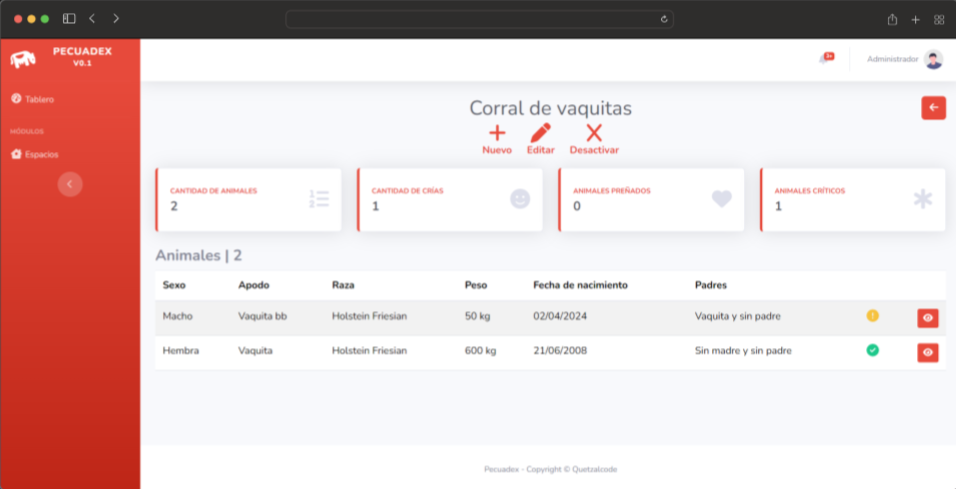
- A dashboard with counts of animals, calves, critical cases and gestating females.
- Production per space (milk, meat, etc.).
- Animal lookup through a REST API that also publishes it in real time over WebSocket/STOMP to the subscribed browser.
Technical decisions
- Spring Boot with Spring MVC and Thymeleaf (server-side rendering), Spring Data JPA on MySQL and Spring Security with BCrypt.
- Species-specific calf rules: the logic determines whether an animal is a calf based on its type and birth date cow 24 months, horse 36, pig 12, sheep 8, hen 6.
- Real time with WebSocket/STOMP (SockJS) to push an animal's data instantly.
- Seed data at startup, so the system can be operated and demonstrated without external scripts.
Result
A working system with a dashboard, management of spaces and of animals with genealogy and states, production tracking and real-time notification. It models an uncommon domain livestock with real rules, not a generic CRUD app.
It is in development and not commercial. The natural next steps toward a production version are hardening the API's security and adding versioned database migrations.